
Located in the root of your WordPress file directory, wp-config.php is one of the most important files in your ClassicPress installation. This file contains the website’s base configuration details, such as database connection information.
When you first download ClassicPress installation files, the wp-config.php file isn’t included. However, a sample wp-config-sample.php is available to provide a guide should you need it. The ClassicPress guided setup process will create a wp-config.php file for you based on the information you provide in the installation process.
Editing the wp-config.php file should be done with technical knowledge or help. While trouble shooting, preferably provided by a technical person or by your host, this page should help.
How to edit the wp-config.phpLink to this section
One needs access rights to the website files via the local/online hosting server in order to edit the wp-config.php file.
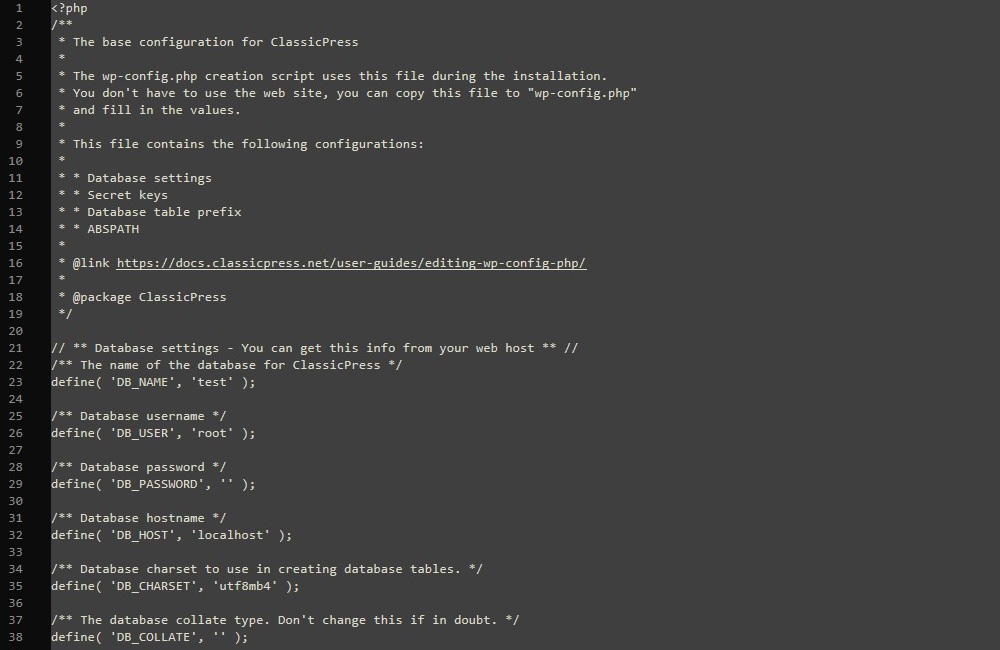
Some hosts offer a file manager with editor to begin any editing work. However, if your host does not allow direct edit access to the files, you can use SSH or an FTP/SFTP client like Filezilla or Cyberduck to download the file. Once you have the file on your computer, any text editing software can be used to make amendments, like Notepad++ or a more complex code editor like VS Code or PHPStorm. The image below shows the file ready for editing in Notepad++.
Plugin and Theme File EditorLink to this section
The Plugin and Theme File Editor makes it possible to edit your plugin and theme files directly from your site’s dashboard.
For security reasons the File Editor is disabled in new installations.
If you want to enable the File Editor, look for the string below and set the value to false.
define( 'DISALLOW_FILE_EDIT', true );
For more info about editing your plugin and theme files see the Editing Files page.
Understanding CONCATENATE_SCRIPTSLink to this section
This setting is built into the ClassicPress core and is intended to optimise the loading of scripts and styling in the admin area of your sites; the setting defaults to true. In this configuration, JavaScript and CSS files are minified and grouped together to reduce load on the server. The advantage derives from a reduced number of HTTP requests on loading the site.
However on more modern HTTP protocols, the advantage is greatly reduced and can actually have a negative impact and slow down site loading times. HTTP/2 and HTTP/3 protocols allow for multiplexing, allowing multiple requests and responses to be sent simultaneously over a single connection. Browser can then leverage better local caching of individual files.
From ClassicPress 2.8.0, the Site Health tests include a check for your site Protocol and will indicate if your site may well benefit from disabling script concatenation. To test if this is the case, add the following line to your wp-config.php file:
define( 'CONCATENATE_SCRIPTS', false );